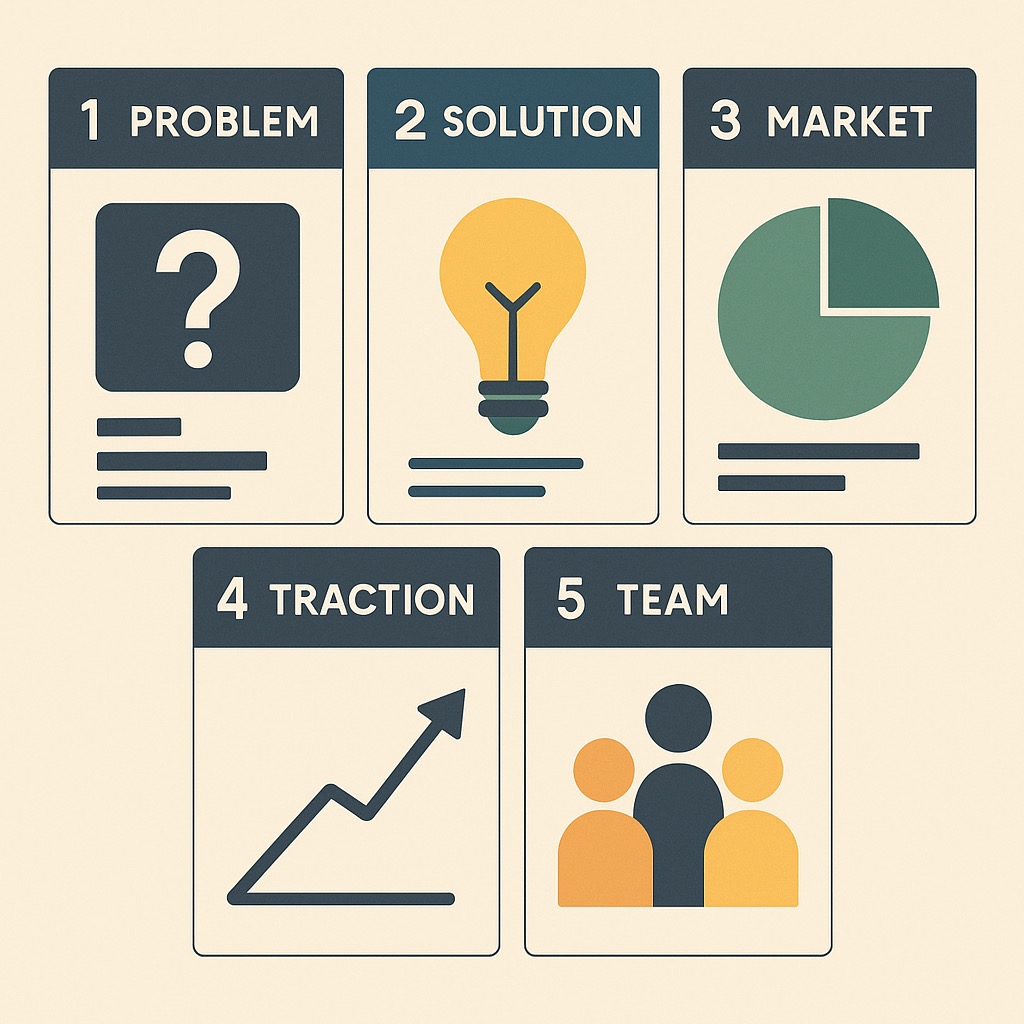
Most founders still believe a pitch deck needs 18–25 slides.
Investors know better.
At Seed Pulse Fund, after reviewing hundreds of decks across biotech, fintech, AI, and frontier tech, one pattern is obvious: only five slides consistently determine whether a founder gets a follow-up meeting.
These slides reveal clarity of thinking, market intelligence, and execution DNA; the traits that predict venture-scale outcomes long before revenue does.
Below is the simplified framework we use internally when evaluating early-stage decks.
1. The Problem Slide: Define the Pain With Precision
The strongest founders articulate a problem that is measurable, urgent, and expensive.
Weak decks hide behind jargon or high-level industry clichés. Investors want to see:
- clear user pain points backed by data
- the economic cost of the problem
- regulatory, operational, or technical friction in the market
When the problem is undeniable, the solution becomes inevitable.
SEO keywords: market inefficiency, industry bottleneck, unmet demand, user friction, cost of inaction, high-value pain point.
2. The Solution Slide: Why Your Product Wins
This is your "one breath" moment.
The Solution Slide must make it instantly obvious how your product eliminates the pain - and why it's uniquely capable of doing so. We assess:
- defensibility (IP, technical depth, patents, proprietary data)
- speed and cost advantages over legacy systems
- how the product integrates into existing workflows
- the "why now" driver (AI tailwinds, regulation shifts, behavioral change)
If the problem is the hook, the solution is the reason we keep listening.
3. The Market Slide: Show a Market Worth Dominating
A beautiful product in a microscopic market isn't fundable.
Investors want a validated market with expansion potential. We look for:
- bottoms-up TAM (not inflated top-down guesses)
- ICP clarity: who buys first and why
- proven acquisition channels
- adjacent markets that unlock multi-year growth
This slide signals whether the opportunity is scalable or simply interesting.
4. The Traction Slide: Momentum Is Your Best Proof Point
Traction doesn't mean revenue; it means signal.
For early-stage companies, that could be:
- pilot data or LOIs
- user activation and retention metrics
- biotech validation milestones
- successful POCs with enterprise partners
- repeatable acquisition loop.
What matters is showing that people use, want, or trust what you're building. This is where real investor confidence is built.
5. The Team Slide: The Real Deciding Factor
The truth: Seed-stage investing is team-first.
We evaluate founder-market fit, technical depth, resilience, and the ability to recruit talent. Strong teams demonstrate:
- domain expertise
- prior execution in similar environments
- strategic clarity
- ability to operate under uncertainty
At SPF, we invest in resilient operators who can scale from zero to one and survive volatility.
Final Takeaway: Minimal Slides, Maximum Signal
Most pitch decks collapse under their own complexity.
But founders who nail these five slides consistently rise above the noise. They communicate conviction, strategic focus, and the ability to execute in fast-moving markets - the traits we prioritize at Seed Pulse Fund.
If your deck nails these five slides, you're already outperforming 90% of founders walking into an investor meeting.